Affiliate disclosure: sew.net earns a commission on purchases made through links on this page. This does not affect our recommendations. We only recommend products we would suggest to a friend.
Essential Sewing Notions for Beginners
A new sewing machine is the starting point. But without the right supporting tools, the learning process is slower and more frustrating than it needs to be. This guide covers what a beginner actually needs: not a comprehensive notions catalog, but the specific tools that matter most in the first year.
The true essentials (buy these first)
Seam ripper
The most-used tool in any sewist’s kit, regardless of skill level. You will make mistakes; a sharp seam ripper removes them without damaging fabric. Replace it when it becomes dull: a dull seam ripper tears fabric rather than cutting thread cleanly.
Recommended: Dritz Seam Ripper (widely available, standard quality, inexpensive enough to replace regularly)
Fabric shears
Fabric shears are scissors dedicated exclusively to cutting fabric. Using them for paper or any other material dulls the blade, causing ragged fabric cuts that affect seam quality. Invest in a quality pair and mark them “fabric only.”
8-inch shears are the standard for most cutting. Smaller 5–6 inch shears are useful for trimming seam allowances.
Recommended: Fiskars 8” RazorEdge Fabric Shears. Consistently sharp, ergonomic, and durable at an accessible price point.
Rotary cutter and cutting mat
For precise, straight cuts through multiple fabric layers, a rotary cutter and self-healing cutting mat outperform scissors. The combination is near-universal among quilters and increasingly used by garment makers for accurate cutting.
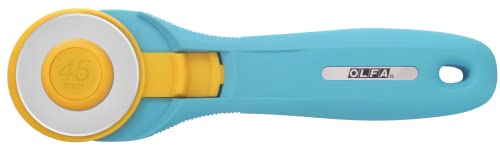
Rotary cutter: 45mm blade is the standard for most applications. Olfa and Fiskars both produce reliable cutters. Replace blades when you notice fabric dragging rather than cutting cleanly.
Cutting mat: A 24” x 36” mat accommodates most projects. Smaller mats work but require repositioning more often. Self-healing mats recover from cuts; non-self-healing mats will need replacement sooner.
Recommended: Olfa 45mm rotary cutter + OLFA cutting mat or equivalent self-healing mat
Olfa 45mm rotary cutter on Amazon | OLFA 24” x 36” cutting mat on Amazon
Pins and pincushion
Pins hold fabric layers together before and during sewing. Glass-head pins are the standard: they don’t melt under an iron, which matters when pressing pinned seams. Bent or dull pins drag fabric; replace them.
A wrist pincushion keeps pins accessible while you sew. A tomato-shaped pincushion on the table is the classic alternative.
Recommended: Dritz Extra-fine glass-head pins + any pincushion
Measuring tape and ruler
A 60-inch flexible measuring tape handles body measurements and fabric lengths. A clear quilting ruler (12” or 18” clear acrylic with grid markings) serves double duty for cutting and measuring flat on a mat.
Check Omnigrid 6” x 24” quilting ruler on Amazon
Iron and pressing surface
Pressing (ironing seams open or to one side) is what makes garments and projects look professionally finished. A steam iron and a firm ironing board or pressing mat are necessary, not optional. Many beginners under-press their work; seams that aren’t pressed open stay bulky and affect fit and appearance.
Any quality steam iron works. A wool pressing mat provides a firm, slightly cushioned surface that’s excellent for pressing seams and is portable.
Rowenta DW5080 steam iron on Amazon | Madam Sew wool pressing mat on Amazon
Hand sewing needles and thimble
Hand sewing finishes (slip stitching a lining closed, attaching buttons) require needles. A basic sharps set covers most applications. A thimble protects the finger used to push the needle through multiple fabric layers. Whether to use one is a personal preference: many sewists don’t.
The next tier: add these when needed
Walking foot: A snap-on walking foot attachment for your machine feeds multiple fabric layers evenly. Essential for quilting; highly useful for sewing plaids, stripes, and heavy fabrics. Often included with machines in the $150+ range; if yours didn’t come with one, it’s an early purchase worth making.
Zipper foot: A narrow presser foot that sews close to a zipper coil. Most machines include one; if yours didn’t, it’s a $5–$15 purchase that’s required for any project with a zipper.
Marking tools: Tailor’s chalk, water-soluble marking pens, or chalk wheels for marking fabric before cutting or stitching. Water-soluble pens (like Dritz) wash out completely; useful for marking notches, dart points, and button placements.
Point turner: A blunt-pointed tool for pushing out corners (collars, cushion corners, bag corners) without piercing the fabric. A butter knife works; a dedicated point turner is cleaner.
What not to buy yet
- Large embroidery hoop sets (unless you have an embroidery machine)
- Specialty presser feet beyond what your machine includes (learn with what you have first)
- Notions kits from dollar stores or unbranded bulk packs (quality is usually poor and dull tools are worse than useful ones)
- Serger thread cones (you need a serger first)
Related guides
Featured products




Dritz Extra-Fine Glass Head Pins, 1-3/8-Inch (250-Count),White

Omnigrip 6" x 24" Non-Slip Rectangle Quilting Ruler by Omnigrid
Last updated: 2026-05-20