Affiliate disclosure: sew.net earns a commission on purchases made through links on this page. This does not affect our recommendations. We only recommend products we would suggest to a friend.
Best Sewing Machine for Garment Making in 2026
Garment sewing has specific requirements that a general-purpose machine may not fully meet. You need consistent tension across varying fabric weights, a reliable buttonhole, stretch stitches for knit garments, and fine needle control for pivoting around curves.
This guide covers what garment sewists actually need: and which machines deliver it.
What garment sewing demands
Stretch stitches. If you sew with knit fabrics: jersey, ponte, ribbing, French terry: you need seam stitches that stretch with the fabric. A standard straight stitch on a knit seam will pop the first time the garment is worn. Look for a triple-stretch stitch, a lightning stitch, or (better) a dedicated stretch stitch option.
Needle up/down control. The ability to set your needle to stop in the down position (embedded in the fabric) is crucial for pivoting around sharp curves, collar points, armhole seams, and any shape that requires repositioning. Without needle-down stop, every pivot requires a manual needle adjustment.
Adjustable presser foot pressure. Different fabrics require different amounts of downward pressure from the foot. Too much pressure on lightweight silk causes puckering; too little on heavy denim causes skipped stitches. Manual or automatic presser foot pressure adjustment is a significant feature for sewists who work across a range of fabrics.
Reliable 1-step or 4-step buttonhole. A consistent, clean buttonhole is one of the benchmarks of garment quality. One-step automatic buttonholes (where the machine sizes itself to the button) are more reliable than 4-step versions. For garments where buttonholes are visible, this matters.
Free arm. The free arm (removing the flat bed extension to expose a narrow cylindrical sewing surface) is essential for sewing sleeves, cuffs, pant legs, and any tubular garment piece. Confirm that the machine you’re considering has a true free arm, not just a narrow main bed.
Our top picks
Best overall for garment making: Janome HD5000
The Janome HD5000 is a mechanical machine with a heavy-duty build that suits the demands of garment sewing particularly well. Its 18 built-in stitches cover all practical garment applications, and the manual tension and presser foot controls give experienced sewists precise command over their results.
The metal frame handles medium-weight fabrics without deflection, and the free arm is genuinely useful for sleeves and cuffs. The HD5000 lacks a computerized display, which some sewists prefer: there’s nothing to malfunction, and the machine’s behavior is completely predictable.
Specs: 18 stitches | 1,000 SPM max | Heavy-duty frame | Manual tension | 4-step buttonhole
Best for: Garment sewists who work primarily with wovens (cotton, linen, medium-weight denim, poplin). Not the first choice for heavy knit work.
Best for sewists who work with knits: Brother CS7000X
For garment sewists who regularly work with stretch fabrics, the CS7000X’s computerized stitch library includes the stretch stitches that mechanical machines often omit. The machine’s LCD makes stitch selection fast, and the speed control slider gives fine control over tricky fabric handling.
The auto-needle threader reduces downtime between color changes: relevant to sewists who work in multiple fabrics per session. The CS7000X handles light-to-medium knits reliably. Very heavy, dense knits (thick sweatshirt fleece, heavy ponte) push the limits of the machine.
Specs: 70 stitches including stretch stitches | Needle up/down | Speed control | 10.5 lbs
Best for: Garment sewists who split time between wovens and knits. A strong all-purpose choice.
Best mid-range step-up: Juki HZL-F600
For sewists at the intermediate-to-advanced level who are serious about garment construction, the Juki HZL-F600 offers professional-grade stitch consistency and a level of tension reliability that mid-range machines don’t match. Its 225-stitch library covers every practical garment stitch.
The automatic thread trimmer is a convenience feature that becomes more valuable the more you sew: trimming threads mid-garment repeatedly adds up. The free arm is standard, and the machine’s industrial heritage means that consistent results on medium and heavy fabrics are the norm rather than the exception.
Specs: 225 stitches | Automatic thread trimmer | Extended workspace | 900 SPM
Best for: Serious garment sewists who sew multiple projects per month and want professional-grade results.
Do garment sewists need a serger?
Yes: eventually. A serger is not a replacement for a sewing machine; it cannot sew construction seams, install zippers, or sew buttonholes. But it does two things that dramatically improve garment quality:
- Overlock finishing: wrapping seam allowances to prevent fraying, creating the interior finish you see in ready-to-wear garments
- Stretch seams: the 4-thread overlock stitch is the standard construction stitch for knit garments and is structurally stronger and more elastic than any standard machine stretch stitch
If you’re sewing garments seriously, adding a serger is a quality and efficiency upgrade. The Brother 1034D is the standard beginner serger recommendation. See our serger buyer’s guide for a full breakdown.
Frequently asked questions
What’s the most important feature for sewing garments?
For most garment sewists, consistent tension is the highest-value feature. A machine that produces clean stitches reliably on your most-used fabric types is worth more than one with 200 stitches and unpredictable tension.
Can I sew denim on a standard sewing machine?
Lighter denim (8 oz and under) is fine on most machines. Heavier denim, multiple denim layers, or canvas require a machine with a stronger motor: the Singer Heavy Duty 4452 or a dedicated heavy-duty machine. Don’t try to sew thick denim on a lightweight computerized machine; you’ll bend needles and stress the motor.
Is a needle-down function important for garments?
Very. Once you sew with needle-down stop, sewing without it feels like a significant limitation. It’s worth paying for if you’re doing any precision work: collars, curved seams, anything that requires frequent pivoting.
Related guides
- Best serger for garment makers →
- Serger vs sewing machine: do you need both? →
- Best sewing machine for beginners →
- Best sewing machine for thick fabric →
- Take the quiz: which sewing machine is right for you? →
Featured products

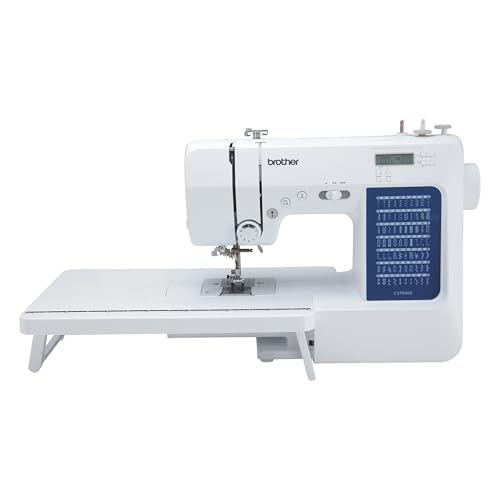
Brother CS7000X Computerized Sewing and Quilting Machine, 70 Built-in Stitches, LCD Display, Wide Table, 10 Included Feet, White

Juki HZL-F600 Computerized Sewing and Quilting Machine
Last updated: 2026-05-20